1 March 2018
Top Five Myths about Ocean Shipping
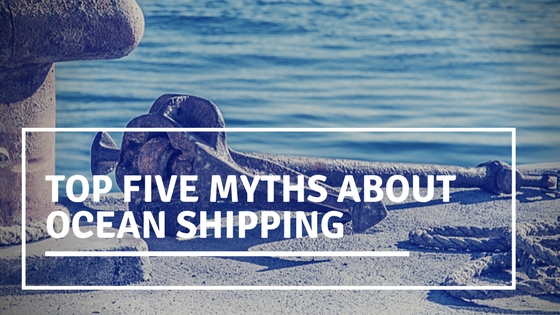
Just like every other industry in the world, the maritime industry is filled with its own list of myths that are constantly being judged in the public eye. As the term suggests, these are but falsely believed notions that have been imparted a status of tradition. Only the seafarers and people associated with ocean shipping know the true story behind these so-called ‘traditional stories’ and have no issues working onboard. Let us take a look at the top five myths revolving around the marine arena and have a shot at debunking them!
Myth #1: Around 10,000 Containers Are Lost in the Ocean on a Yearly Basis:
Seriously? That’s a huge number and an even huger accusation, truth be told. Yes, some containers do go haywire during the cargo shipping, but the number is nowhere close to 10,000. However, some tragic and large-scale mishaps have tainted the reputation of the maritime industry, with the MOL Comfort and the MV Rena incidents topping the list. On June 27 th 2013, the MOL Comfort cargo ship had broken in half and inevitably drowned while traveling across the ocean and till date, this remains to be the worst maritime tragedy in the world. This single accident resulted in the loss of 4,293 containers! Following suit, in 2011, the MV Rena vessel was stranded on a reef near the New Zealand coastal area, which caused 900 containers to topple over the side of the vessel.
Apart from these only-a-few high-profile accidents, the World Shipping Council deduced that around 546 containers were lost overboard during the period of 2008-2013. What people need to realise is that the ocean shipping industry is indeed as vast as the ocean itself, and it involves a colossal number of vessels on water. With such an incredible number of ships sailing on the sea, loaded with mountains of cargo, it is not really a surprise if some containers do tend to get lost at sea and do not reach the shore. Before we judge the authenticity and credibility of the container shipping, the thing to be brought into the light and considered is that an estimate of 120 million containers are yearly shipped across the world, and only 1,679 lost containers seem like a number that can be tolerated.
Myth #2: Seafarers Are Threatened by Pirates Very Often:
This myth clearly seems to be an influence of reading too many pirate-related novels or watching too many Hollywood flicks. Pirate attacks in the ocean are not an obsolete affair by any means, but in these modern times, the attacks are pretty much lessened and happen very rarely. It is true that there is a steady increase in the pirate formations in Somalia, which does not imply that the entire ocean is teeming with the rogues! Nowadays, strict measures are observed by the ships to prevent any weakness or breach of security. With the advent of technology and advanced defense mechanisms, the pirates are lying low and finding it hard to attack or impregnate the vessels.
Myth #3: Coastlines Have Distinct Boundaries:
If you are aiming to be a sailor by profession, the knowledge of basic geography will not work at sea. The most common misconception is assuming that all the coastlines have clear boundaries between the sea and the shore. Generally, the shorelines are established where the land ends and the sea waters begin. But, these distinctions are not man-made and they are not very well-established or easy to distinguish. Most of the time, the sea waves move in and out of the coastal lines and tides form due to the influence of the moon. With so many factors influencing the overlapping of the land and ocean, the indistinct concept of the shorelines have long confused the sailors and it is not as easy to maneuver the ships as it may seem to a layman.
Myth #4: The Tropics Are the Hottest Regions in the Ocean:
We believe that the tropical parts of the ocean are probably the warmest, due to their geographical proximity to the Equator that endures direct rays of the sun. However, this logic works mainly for the land, as it has been found out from extensive research that the warmest waters in the ocean actually lie quite deeper. Surprisingly, these warm waters might not even be situated on or near the tropics. This occurs due to the simple fact that where the Earth’s crust lies thin beneath the ocean, the hot core of the Earth heats up the waters. The seafarers are well aware of this and it does not influence their decisions, otherwise.
Myth #5: Seafarers Always Suffer from Seasickness:
Now, this is one irritating question all sailors face. No, seasickness is not that common a problem and very few actually experience it. It is very similar to motion sickness and is extremely subjective in nature. Even if a sailor goes through it, he can easily overcome it!
Would you like to help us bust more myths? Write to us and we will add it to the list!


.jpg)