8 May 2018
IMO Calls for Cutting Emissions in Half by 2050
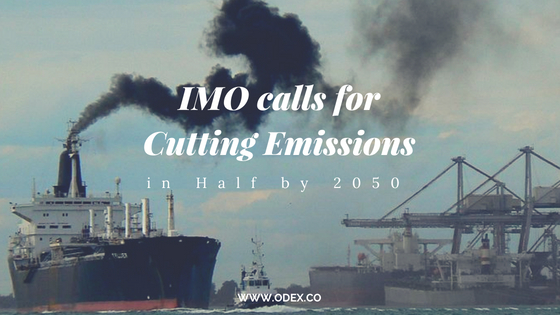
From our cell phones to the food on our table – most everyday items are touched by international shipping. And in this everyday scheme of things, where, even as I write, over 50,000+ ships travel the world’s oceans – we often fail to realize that Shipping contributes close to 3% of the world’s total GHG (Green House Gases) emissions. And it is projected to increase by 50 to 250% in the next 30 years – based on whose estimates you’d want to believe – contributing to one-fifth of the world’s emissions.
Ships are extremely fuel-efficient in terms of transporting cargo, but the heavy fuel oil (HFO) used by 80 percent of the world’s shipping fleet is nasty stuff. It’s more carbon-intensive than other fuels and produces other greenhouse gases as well as air pollutants such as sulfur dioxide, which causes acid rain.
Last month IMO members met under the organization's Marine Environment Protection Committee (MEPC) to discuss a package of measures to reduce emissions from international shipping. They were greeted by the sign of “Don’t Sink Paris” – etched into the muck of Thames River Bank – opposite the IMO summit venue. The lack of apostrophe in DONT does not take away from the message that it screams out.
Much was expected of this summit – with the complexity of Shipping ensuring that a deal is difficult to arrive at. Not least of all being the challenge of which country to hold responsible for emission cuts – should it be the country under whose flag the ships are registered; exporting countries; importing countries; transshipment hubs.
Adding to these complexities – is the nature of trade. Slowing down ships by 10% to reduce fuel usage by one-third is often not a viable solution for exporters of perishables. It will also render many other goods and raw materials more expensive– thus making many shippers uncompetitive.
So the news of IMO committing itself to a reduction of 50% on 2008 emission levels by 2050 was received with some degree of elation and a lot of caution. The EC and EU countries would have liked to see a cut of 70% to 100%.
Before this meeting, several delegates –especially from Marshall Islands – the world’s second largest Ship registry nation, and also a low lying country likely to be affected by rising ocean level - argued only 100% GHG cuts by 2050 would be consistent with the 2015 Paris Agreement's goal of limiting global warming to 1.5 degrees Celsius over pre-industrial levels. The words "at least" in the strategy for the 50% cuts may have been key to securing the support of these more ambitious countries, suggesting that the cuts may be intensified at a later date.
In the past, the EU has threatened to include shipping in its emissions trading system if the IMO does not implement a satisfactory GHG emissions strategy by 2023. IMO delegates and officials are hoping the EU will seek to toughen the cuts at future MEPC (Marine Environment Protection Committee) meetings rather than imposing its own measures at the regional level.
Also, the level of attention that this years’ summit has attracted is far beyond what it has usually seen. Protestors were seen handing out boarding cards urging participants to commit to reducing emissions immediately and drastically.
IMO is expected to start developing legally binding measures, which could include increases in ships technical and operational efficiency, a low and zero-carbon fuels implementation programme, national action plans and market-based measures. These would be in addition to existing measures on energy efficiency (EEDI and SEEMP).
Voluntary action by the industry and governments will also help deliver technology and infrastructure to deliver the Strategy objectives.
Also, the Ships of 2050 will look very different from those today. It is difficult to predict the future, but we expect to see a diverse range of zero-carbon technologies/fuels deployed across the world’s fleet. For example; batteries, hydrogen, ammonia, sustainable biofuels, and sail.
There is a range of innovative technologies already being piloted and deployed and we expect the curve of technological innovation to increase with the adoption of this strategy.
A comprehensive, widely acceptable and cost-effective solution can be found if all stakeholders can agree to work towards the goals of Paris.
Else, we may just have to gear up for a legally binding mandate on emission cuts.
Watch this space for more on the issue that affects us and our future generations!!!
References:
https://www.platts.com/latest-news/shipping/london/imo-greenhouse-gas-cuts-present-unprecedented-21790483
https://www.economist.com/news/business/21740451-some-countriesand-companiesare-fighting-green-tide-shipping-industry-attempts-cap



.jpg)