14 May 2019
Maritime Industry: Autonomous Shipping To Be Governed By Global Rules
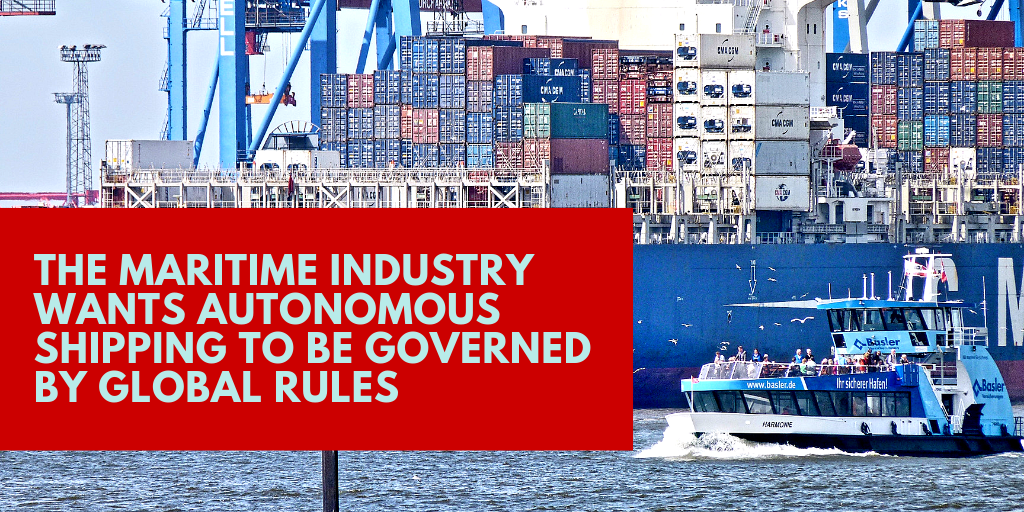
With every passing day, the maritime industry is gradually developing fast and is embracing new concepts and innovative ideas. Nowadays, the notion of autonomous shipping has taken concrete shape and is being integrated into the shipping procedures and global operations. Now that autonomous shipping has finally become a reality, it will soon be implemented into the daily system of maritime operations to ensure the smooth functioning of the vessels. With the steady progress in the arena of sensor technology, the remote-controlled vessels are aimed at increasing the level of connectivity at sea. By adopting the modern methods of autonomous shipping, we can usher in a new era of the shipping industry by reducing the congestion in roads, decreasing the maintenance costs and enhancing the safety measures.
Of recent, the topic of autonomous shipping keeps cropping up at debates and conferences organised within the maritime industry and the issue is gaining momentum every day. According to the opinion of the CEO of Dualog, Morten Lind-Olsen, the focus should be on a global set of rules targeted to govern the autonomous shipping, which is urgently in need of a global coordination and legislation. Sharing his views on the trending topic, Lind-Olsen has stressed on the necessity of aligning the newfangled, shipping procedure at the panel discussion on Fleet Management of the Future during Sea Asia 2019. Since it takes a considerable amount of time for the IMO to come up with the set of rules, it might take around 5-15 years for the autonomous shipping to be controlled by worldwide regulations.
The new-age concept of autonomy has the strong potential to transform the current state of the industry into something that is way more safe, more eco-friendly and of course, more efficient than ever. However, the debate is still going on as to whether there is a need for an autonomous vessel to be manned or not since many are of the opinion that a completely unmanned ship can become vulnerable to a lot of risk factors. Full-fledged implementation of autonomous shipping still has a long way to go. The fact the initial adoption of this modern-day technology has not been for a mainstream, deep-sea vessel but has rather been utilized in the case of coastal support in Norway, ascertains the gradual development of autonomy in a linear, incremental manner.
Yara Birkeland is a battery-driven vessel that runs on autonomy and is being used to transfer fertilizer products from Porsgrunn in Norway to the ports of Larvik and Brevik. The ship is under close observation as it can prove to be extremely beneficial by cutting down on costs, maintaining the safety measures, consuming lesser fuel and being more responsible towards our environment. But we cannot deny the fact that the success of autonomous vessels can lead to the problem of unemployment for many seafarers, who earn their living by working at sea. Addressing this logical question, Sanjeev Namath (the Chief Business Officer of Alpha Ori Technologies) has highlighted the fact that technology also has the power to create new jobs, if it indeed leads to a case of widespread unemployment. Namath is certain of the fact that with the advent of new technologies, the marine professionals can find new jobs (such as drone operators and control centre operators) that require the skilled monitoring of modern equipment.


.jpg)