22 March 2018
Summer Kiwi Refreshing Drink
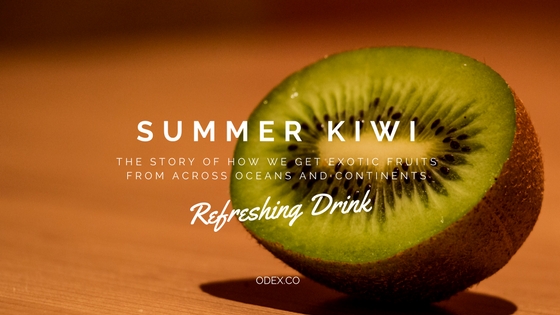
The story of how we get exotic fruits from across oceans and continents
With the steady progress in the world of technology, gradually the list of limitations is decreasing and soon, there will be nothing that cannot be achieved! Including getting a refreshing summer kiwi drink that made with Kiwis imported from New Zealand.
Of recent, the advanced technology has provided a great boost to international trade and globalization has contributed a lot to this success. Nowadays, it has become a lot easier to transfer food over millions of miles, due to an improvement in the standard means of transportation- mainly via air travel or ocean shipping.
If we take a good look at the historical facts, food travel had always been carried out despite the several problems it presented.
Since the Europeans had sourced tea leaves all the way from China, transportation of preserved food (that cannot be grown locally) has come a long way, given that this particular industry is growing day by day with better results.
Over the past few decades, fruits, in particular, have been frequently and most importantly, efficiently transported across seas and countries to deliver them to their destinations.
Why is the ocean route so popular?
Arguably, the sea freight has been considered as the most preferred way of transporting fruits (or food, in general), simply because it is cheaper than the other modes of travel.
Nowadays, the demand for exotic fruits has risen tenfold as everyone is aware of the numerous health benefits of eating the tropical fruits like carambola, lychee, passion fruit, cashew apples, avocado, pitahaya, and of course, kiwis!
There are specialized ships like the refrigerated cargo and container vessels, which helps in simplifying the rather complicated journeying of the exotic fruits, generally from one continent to another.
Sometimes, the fresh produce of exotic fruits is sourced from the developing countries to Europe or the United States.
The main criteria for a safe, balanced transportation is to deliver fruits that are not only clean and fresh but also are free from external moisture, pests, damage, foreign smell or any funny taste.
Packaging:
When it comes to packaging, the sizes vary with the type of exotic fruits as stated by the current marketing standards. The market segments and the clients are the ones to decide on the packaging requirements, with the priority being on quality to avoid any bruising or damage.
There are some rules and regulations regarding the consumer package labeling, especially that the packages cannot be labeled with any toxic ink or even glue. The labels of the packaging of exotic fruits should contain the relevant information like the product/ fruit name, producer/packer name and details, product origin, country name, commercial data (like class, size, net weight, number of units etc.), traceability code (including the GLOBAL G.A.P. and GG number), certification/retailer logo and optionally, the official control mark.
Vessel Design:
The container vessels are specially designed to enable an efficient and swift transportation of the exotic fruits. The goal is to preserve the fruits in such a way that they retain their high quality and the optimum ripeness as desired by the markets.
The shipping vessels apply the controlled-atmosphere (CA) technique to transform the exotic fruits into a passive state so that the ripening process is slowed down naturally. This can be achieved by adjusting the temperature of the containership to that of the cargo goods (in this case, the fruits) it is carrying, simultaneously altering the atmospheric composition to attain the perfect degree of ripeness.
The container vessels should ensure that the products are being handled by expert hands, as the level of temperature and the level of the gases involved (Oxygen and Carbon Dioxide) are to be constantly monitored in the controlled environment. With the advent of smarter technology, the cargo ships are now attempting to use the ‘ripening gas’ or ethylene to spill over the artificially constructed, controlled environment to bring out that high quality of freshness in the exotic fruits. This is an extremely eco-friendly procedure, no doubts whatsoever.
Food Transportation and Environmental Pollution
Is my refreshing kiwi drink costing anything to the ocean?
Unfortunately, yes.
The food transportation has one major disadvantage – it causes pollution, which is definitely a big issue to deal with. We cannot deny the factor of ‘environmental cost’ involved in the international food trade, which is measured in ‘food miles’ or the amount of carbon dioxide generated per mile for a tonne of food.
The level of pollution is actually measured by tracking the carbon footprint of the food product (here, the exotic fruits) that in turn, record the intensity of greenhouse gas emissions during the production and distribution processes of the food. The reason behind this is the emission of the carbon dioxide gas that causes global warming extensively. The interesting fact is that it is not always the long duration of transferring food that causes pollution.
According to research, fruits kept in cold storage for a long time can consume much more energy and have a negative effect on the atmosphere.
However, the good news is that the cargo containerships cause the lowest impact on the environment since they emit the lowest levels of harmful carbon dioxide.
That being said, let’s enjoy the weekend with a refreshing kiwi drink in our hands!


.jpg)