24 October 2018
Autonomous Ships And Where to Find Them
Just like what the smartphone had done more than two decades ago, the autonomous shipping industry is here to be disruptive and revolutionise the landscape of both ship and road operations. Futuristic, yet critical - it is important for a vehicle to be able to monitor its own health, understand its surroundings, and make decisions. In this article, we take a detailed look at how these two industries are looking at automation as a solution to improving their operations.
Ocean Shipping
There are hundreds of “ghost ships” that could be plying the seas within a decade under plans to amend International rules that prohibit unmanned cargo vessels. Talk about spooky!
At its meeting in mid-June, the Maritime Safety Committee (MSC) 98 agreed on proposals for a scoping exercise that will determine how the safe, secure, and environmentally sound operations of Maritime Autonomous Surface Ships (MASS) may be introduced in IMO instruments.
It simply means that IMO will consider changing the International Convention for the Safety of Life at Sea (SOLAS) to allow ships with no captain or crew to travel between countries.
As usual technological advances are moving ahead of regulations. We will see at least 3 unmanned vessels at sea by 2020, with early testing expected this year in 2018. We’re practically living in the future of technology! The list consists of the usual suspects – the Scandinavians, the British and the Chinese.
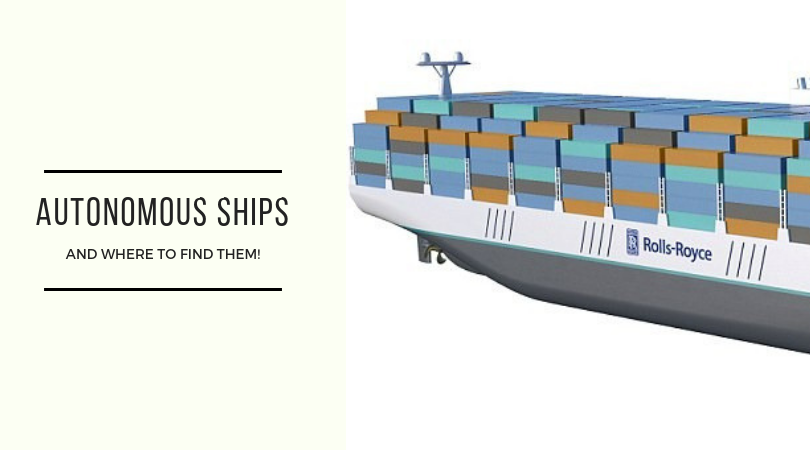
Rolls Royce of Shipping
Source: Rolls-Royce
Not surprisingly one of the ghosts slated for a 2020 launch of unmanned Cargo Ships is Rolls Royce. In a Whitepaper published in late 2016, Rolls Royce outlines its vision to make this a reality. It’s very exciting!
According to Rolls Royce, autonomous Ships will save on costs, weight and space – with the removal of crew accommodation and decks – thereby allowing the ship to carry even more containers. Rolls Royce imagines that an on land crew equipped with smart sensors, cameras and drones will control multiple ships at the same time.
Artificial Intelligence will also play a major role to ensure intuitive predictability and situation awareness – enabling the ships to navigate tight spots and hazardous situations. Imagine ships being able to navigate through treacherous waters! Maybe Titanic would have had a chance and avoided the iceberg. Some of these aspects include sensor fusion, control algorithms, and communication and connectivity.
These three areas help vehicles in a couple of ways. It involves a technology that allows vehicles to gauge its surroundings, allowing them to navigate to safety. This technology includes radars, high-definition visual cameras, thermal imaging and LIDAR the project has concluded fusing multiple sensor inputs provides the best result. The inputs received need to be implemented in a way that allows the ship to navigate the rough seas, which involves the use of control algorithms. Talk about complex!
Rolls-Royce did a ghost-ship demo in June 2017 in which a 28-meter vessel berthed itself, undocked, turned 360°, and piloted itself to back to the starting point before docking again — all via remote control, on land.
Many have also been banking on the economic benefits of this. At a vessel level, this includes a more efficient use of space in ship design, crew and their skills, and use of fuel. Optimizing processes or operations based on the real-time data that comes from ships enables economies of scale at fleet as well as reducing the likelihood of human errors, which contribute to both safety and service quality.
Source: 21 st Century Tech
With the increasing complexity of roadways, the EU has been working towards making short sea shipping more competitive with road and rail transport. Furthermore, crewing costs are estimated to be only a small six per cent of the overall cost of running a ship, while capital costs are about 42 per cent, and voyage costs (including bunkers) run about 40 per cent. Clearly, shipping is more capital intensive than labour intensive. This also means that while manual labour might no longer be needed, on decks, they will need to be replaced with a capable workforce who can learn and handle autonomous ships.
If regulatory hurdles are crossed soon, we will see autonomous/crewless vessels soon plying the high seas.
Driverless Trucks – Improving Freight Shipping
Former secretary-general of the International Transport Forum (ITF) José Viegas predicts driverless trucks to have a regular presence on the roads within the next decade. Several manufacturers in the US and EU have been investing in automation, with governments actively looking at reviewing their regulations. You know that things are moving forward if International bodies are working towards modifying their regulations for advancing technologies.
Volvo Group has already taken a massive step forward in this direction. They already have a fully automated truck which has been recently demonstrated in China where the driverless truck drove between delivery hubs without the need for a human operator. In an industry with huge costs, this initiative will remove up to 45 per cent of total road freight costs.
This has raised some concerns about the trucking workforce. In a study conducted by ITF in May 2017, it was revealed that 4.4 million of the 6.4 million professional trucking jobs in both the US and Europe combined could be eliminated due to autonomous technology. Truck drivers, as self-reliant and flexible as they are, have a relatively low education level, leaving them at risk for unemployment for longer periods.
Many see this innovation as a solution to their recruiting problems. Autonomous vehicles will help the sector compensate for the current shortage of drivers in many parts of the world.
Automation, however, doesn’t mean a complete cut down in jobs. There are still certain aspects of the shipping process that cannot be done automatically. This includes roles that will help monitor the truck and even control them remotely if necessary. Furthermore, cargo needs to be manually loaded and unloaded which can be seen as a difficult area to automate.
Due to the complexity of this technology, this will be implemented gradually. Experts predict that in the initial run they might require drivers even during high degree of automation that falls short of full self-driving capability. The slow introduction of the technology will allow for a gradual retraining of the workforce, and a managed transition to the new technology. It gives those working in the industry time to accept the change instead of rejecting it as soon as it arrives.
There are still few hitches that need to be fixed before road cargo can go completely human-less such as difficult turns and junctions, finding a way to manage the several brands of carriers within a fleet, among others.
We sure have an interesting decade coming up with ghost ships and trucks. Not to mention vacuum trains – but more about that next time!
[As published with AMTOI]


.jpg)