4 January 2018
The Future has Arrived and it is Crewless
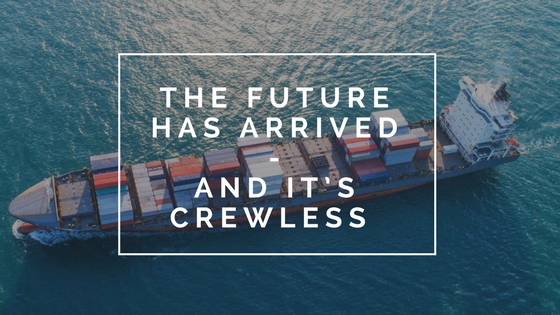
Hundreds of “ghost ships” could be plying the seas within a decade under plans to amend international rules that prohibit unmanned cargo vessels.
At its meeting in mid-June the Maritime Safety Committee (MSC) 98 agreed on proposals for a scoping exercise that will “determine how the safe, secure, and environmentally sound operation of Maritime Autonomous Surface Ships (MASS) may be introduced in IMO instruments”.
It simply means that IMO will consider changing the International Convention for the Safety of Life at Sea (SOLAS) to allow ships with no captain or crew to travel between countries.
As always though, technological advances are moving ahead of regulations and we will see at least 3 unmanned vessels at sea by 2020, with early testing expected in 2018. The list consists of the usual suspects – the Scandinavians, the British and the Chinese.
Here’s a sneak peek at the future of Ocean Shipping:
The Yara Birkeland
2017 saw the launch of Yara Birkeland– expected to be the world’s first Crewless Ship by 2020. Yara, the Norwegian agri-fertiliser company – unveiled the Yara Birkeland, in May 2017. It is touted to be completely crewless and can carry upto 120 TeU’s.
The ship has been named after Yara’s founder Kristian Birkeland and will be the world’s first fully electric and autonomous container vessel upon completion. Operation is planned to start in the latter half of 2018, shipping products from YARA's Porsgrunn production plant to Brevik and Larvik in Norway.
Built in collaboration with Konsberg, it will initially be a partially manned vessel and is expected to be a fully automated vessel by 2020.
The cutting-edge vessel will avoid 40,000 road trips from Yara’s Porsgrunn fertiliser plant to the ports of Brevik and Larvik, while reducing the level of NOx and CO2 gasses emitted by haulage trucks.
Using the Global Positioning System, radar, cameras and sensors, the electric ship is designed to navigate itself around other boat traffic and to dock on its own.
The vessel will cost $25 million, about three times as much as a conventional container ship of its size, but without the need for fuel or crew it promises to cut annual operating costs by up to 90%.
The Birkeland will become autonomous in stages. At first, a single container will be used as a manned bridge on board. Then the bridge will be moved to shore and become a remote-operation center. The ship will eventually run fully on its own, under supervision from shore, in 2020.
Rolls Royce
Rolls Royce is also aiming for 2020 for the launch of unmanned Cargo Ships. In a Whitepaper published in late 2016, Rolls Royce outlines it’s vision to make this a reality.
According to Rolls Royce, autonomous Ships will save on costs, weight and space – with the removal of crew accommodation and decks – thereby enabling the ship to carry more containers. Rolls Royce imagines that an on land crew equipped with smart sensors, cameras and drones will control multiple ships at the same time.
It will also rely heavily on AI to ensure intuitive predictability and situation awareness – enabling the ships to navigate tight spots and hazardous situations.
Rolls-Royce did a ghost-ship demo in June 2017 in which an 28-meter vessel berthed itself, undocked, turned 360°, and piloted itself to back to the starting point before docking again — all via remote control, on land.
Great Smart – The Smart Chinese Ship
A 38,800-metric ton bulk carrier, named Great Smart, conducted a weeklong trial in early November 2017, in Guangzhou and will be delivered to an unidentified lessee.
The company calls it the world's first smart ship because it is the first seafaring vehicle awarded the "cybersafe", "cyber-perform" and "cyber-maintain" smart-vessel notations by the British maritime classification society Lloyd's Register.
Great Smart has a set of integrated information systems capable of autonomously monitoring, recording and analyzing the conditions and operations of major equipment such as engines and propeller shafts.
The data reduces the crew's workload, improves efficiency and avoids misjudgments.
Though it has not yet resulted in a Crewless vessel, it is a possibility in the near future that these vessels can be controlled by a land-based crew – completely eliminating the need for an on-board crew.
Apart from the above 3, several of Japan’s largest shipping outfits have reportedly joined forces to develop a fleet of 250 remote-controlled cargo ships that could be launched by 2025. The Japanese government is supporting their initiative, backing research into data transmission efforts and standards around autonomous vessels.
If regulatory hurdles are crossed soon, we will see autonomous / crewless vessels soon plying the high seas.
And I thought such sightings were common only around the Bermuda Triangle !!!
The Future is truly Now !!!
If you would like to learn still more, watch the video from Rolls Royce


.jpg)