13 July 2018
Supply-demand Seen Improving in Container & Dry Bulk Shipping Segments
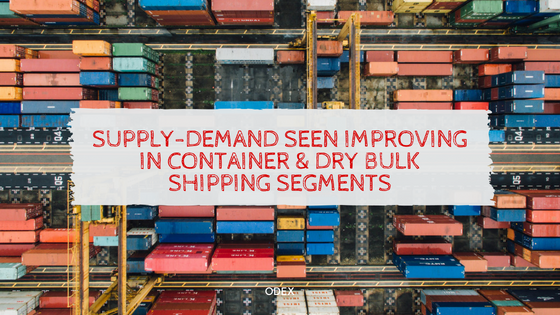
It has been predicted that the year 2018 will experience the rise of supply-demand in the container and dry bulk segments of the global shipping industry. As per the data analysis provided by the S&P Global Ratings, it is certain that the three major segments of the shipping world (namely the dry bulk, tankers and containers) will outpace supply and this is a phenomenon that has not occurred since many years in this field.
The increase of supply-demand ensures a future stability that will prove to be extremely beneficial to the global shipping sector for at least 12 months. There will a boost in the growth of the overall sector earnings by 4-5 per cent . The lighter new ship delivery schedule for 2018 indicates to rising charter rates in the marine industry, as compared to the earlier year.
In fact, this year will also fall in place with the high expectations of longer distance travelled and sustained imports of commodities. However, the container liner sector might experience flat rates even though assumptions point towards a broad macroeconomic growth along with a confirmed growth in trade. Moreover, S&P Global Ratings is of the opinion that the fundamental improvement in supply conditions will eventually lead to the much-needed recovery of shipping rates that will not cease to continue beyond 2018, as well. This tentative statement can be realized by the ship order books being at close quarters to its lowest level ever reached.
To throw light specifically on the dry bulk segment, the total size of the global dry bulk fleet has increased by 1 per cent as recorded till April 2018 by Moody’s report. This is a positive turn of events and more growth is expected in the remaining months. Experts believe that demand will soon outstrip supply by around 1 per cent , to say the least. Though we see the charter rates gradually going up, it is definitely going to stay volatile. On the other hand, the tanker sector will remain engaged with important new deliveries this year after going through a supply growth in the last one. It is estimated that the crude tankers will definitely steal the show in 2018.
The inevitable downside of an improving supply-demand ratio is that the vessel owners will make the grave mistake of ordering more after learning the forecast of a better tomorrow. This can eventually make a mess of the anticipated supply trend and restrict the charter rates. But, if we bring the normal lead-time leading to delivery in 18-24 months into question, the supply rates are going to run slow even if there is an ordering spree in the upcoming months. It is believed that if ship owners can resist the temptation of aggressive ordering, the charter rates can continue increasing till 2019.
As we are aware of, the dry bulk vessels are concerned with the transfer of raw materials of global trade commodities, such as iron ore, coal etc. In relation to the recent predictions made for the dry bulk segment, a combination of supporting fundamentals will probably enhance the dry bulk shipping rates in 2018. Incidentally, the dry bulk vessel order book represents 8% of the global fleet as recorded of recent. Back in 2017, the dry bulk segment had faced a huge rebound in its charter rates because the growing demand for commodities had outpaced the fleet expansion. This current trend of the demand growth is more than the net fleet growth and it will continue triumphantly till China keeps importing commodities to run its economy. After going through a rebound in the last year, the vessel utilization rates will undergo a quick recovery.
Now coming to the container shipping segment, the average freight rates on significant trade lanes has risen to a sustainable standard in 2017. This was a direct consequence of supply-side measures, streamlining of active networks and improved trade volumes. The freight rates scenario still remains at risk in spite of decent supply and demand conditions of ocean carriers. The scheduled delivery of ultra-large vessels in 2018 can have a negative impact on the rebound in freight rates. The major Asia-Europe lane is most likely to be threatened by this development.
The Clarkson Research has highlighted the fact that the current order book for post- panamax container vessels (with a capacity exceeding 15,000 twenty-foot equivalent unit) might double the strength of the global post- panamax fleet in a short period of 2-3 years. The supply burden is reflective of how the leading container companies are capable of capacity management, which can affect the freight rates. Unfortunately, the major liners in the industry like the CMA-CGM and MSC have already ordered 20 large containerships. This decision can influence other container liners to follow suit and place orders to win the market shares.


.jpg)