6 July 2018
Outlook for Indian Logistics Industry in FY19
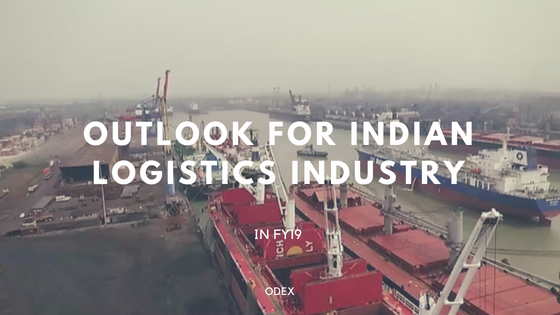
The logistics industry is rapidly developing in India. Being the backbone of the economy, the logistics sector is constantly improving to provide a cheaper flow of goods. The growth in the Indian logistics industry is directly proportional to the growth in e-commerce, retail, manufacturing sectors. Let us evaluate the position of the logistics industry with respect to the FY19.
A Decline in Correlation Between Freight Rates and Diesel Prices
As per the data analysis conducted by the India Ratings and Research (Ind-Ra) organization, the correlation between the freight rates and diesel prices has recently dropped down to 0.03, as compared with the average correlation of 0.73 for a long period.
According to the Ind-Ra, this steep decline is a result of the competitive pricing by big fleet operators. Another reason is the ever-increasing, intense competition among the STOs, which accounts for approximately 90 percent of the truck volumes in our country.
Rail Freight Volume Will Grow During FY19
With respect to the freight volumes, the Indian Railways have reported a 4.95 per cent y- o-y growth even though a dull performance was recorded in the 1HFY18 till January 2018. Subsequently, the Indian Railways were able to recover from their sudden decline (in the period between the FY14-FY16) through the waiver of the surcharges experienced in port congestion and the removal of dual iron ore charges.
Moreover, the Railway industry is planning to reduce customer attrition like the long-standing freight contacts in order to promote a surge in rail volume growth.
Warehousing and Cold Chain
As we are aware of, a healthy agricultural yield and the rising demand for key commodities ensure a boost in the cold storage utilization rates throughout the country. Unfortunately, the occupancy level is greatly affected by agro-climatic risks that can be quite unpredictable.
As a consequence, the cash flow is largely dependent on the monsoonal changes and the overall evaluation of the agrarian economy. It has been predicted that the warehousing sector will experience a higher capacity utilization because of increased demand for textiles like cotton. Industries like the retailing, automobile, consumer durables etc. are expected to see a growth in the normal volumes.
Ind-Ra has also put forward the fact that the FY19 will see a demand in the implementation of advanced technology through warehouse management systems, material handling equipment, and automated pellet racking.
Ind-Ra believes that the warehousing scenario in India will be further controlled by the consolidation of smaller warehouses and the appearance of significant warehousing hubs. The Indian market is predominantly broken into small-scale warehouses that are scattered throughout the country. It is important that larger players will emerge to enhance consolidation by developing the integrated and advanced facilities. It will be interesting to see how GST will affect the logistics and warehousing sectors. If we go by the assumptions made by Ind-Ra, the GST changes will trigger the formalization procedure and with time, unorganized players in the organized sector will decrease the wallet share of unorganized enterprises.
Ind-Ra suggests the expansion of major warehousing hubs around the key ports in Western and Southern parts of our country. Nagpur will definitely continue its esteemed position as an important warehousing hub owing to its highly convenient, central location. In fact, the Indian Government is planning to amplify the potential of Nagpur as a National Investment and Manufacturing zone.
On the other hand, it is apparent that Guwahati will soon be declared as the largest warehousing centre because it is flooding with large FMCG players. Ind-Ra has highlighted the growth of a unified marketplace as the main advantage of GST and consequently, the evolution of the regional warehousing centres.
Rationalization of Regional Disparity
With the onset of 4QFY19, Ind-Ra is of the strong opinion that the regional disparity concerning the warehousing capacity utilization will subside after the application of GST. The period between FY19 and FY21 will play a vital role in the consolidation of warehousing facilities and a better future for the consumption-driven sectors.
Moreover, it is now certain that the cash flow of the large warehousing players will undergo an improvement from the start of FY21. However, the free cash flow will be somewhat restricted during the FY19 as a result of the incremental investments regarding the strengthening of operations.
Agri-logistics and Cold Chain Still Face Inadequacy
Since the investments in the field of agri-logistics and the cold chain segment are still not up to the mark, there is a huge wastage of agricultural produce in the country. This can be solved by enhancing the level of private participation in the sale of agri-products along with the continuous progress of organized retail.
The future prospects for further investments are looking up and incumbent organizations are also willing to offer end-to-end logistics solutions. In the last two years, the large-scale investments from the private equity players have accentuated the suitable opportunities for investment.
The Department of Industrial Policy and Promotion has thrown light on this matter and has stated that the nation’s agricultural services have successfully attracted $1.99 billion as foreign investment from April 2000 to September 2017.
Consolidation of Container Freight Station (CFS) Capacity
The Customs Department has decided to lessen the handling and clearance time to 60 hours at several ports across the country. In the matter of exports, the direct port entry enables the exporters to avoid wasting time with freight agents and to directly transfer cargo to the vessels.
The Indian Government is even planning to reduce the original port delivery time to just 24 hours. The introduction of a mobile app to pre-book road freight services will positively come in handy. But, Ind-Ra is wary of the fact that a depletion in the compliance and handling costs will eventually affect the credit profile of the involved players in the CFS segment.
As a direct consequence, the capacity utilization of various CFS (regarding the ports) will be under pressure in the near future. This may bring forth a rationalization of the CFS capacity across the ports in India.


.jpg)