1 June 2018
Eight Shipping Trends of 2018
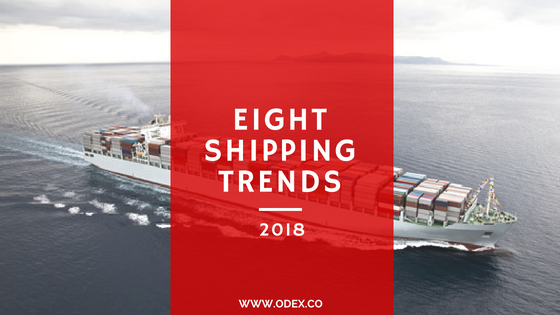
We’re all a big fan of following trends that happen around us. In the line of that, below are 8 major shipping trends that we are pleased to see in effect during 2018. These innovative trends are set to provide a great boost to the maritime industry and fuel its rapid growth in future.
Voyage Optimization :
The advancement in technology has made it possible to predict weather conditions quite accurately, thus making the journeys seem much more comfortable and hassle-free. With such pre-informed data, it becomes easier for the ships to decide on their course of action, safe routes etc. The active practice of voyage optimization has also decreased the consumption of fuel and reduced the carbon footprint, by choosing the more energy-efficient routes.
Enhancing Propulsion Efficiency :
Another popular trend is the optimization of the propulsion efficiency in cargo vessels. With the introduction of many cheap procedures, it has now become possible to reduce the harmful carbon emissions along with the huge amount of fuel consumption. The Hi-Fin technology provided by the Hyundai Heavy Industries (HHI) is in high demand because it effectively enhances the performance efficiency of any cargo-loaded vessel while being very cost-effective. The gadget works by generating swirls of its own to neutralize that of the propeller system and hence, reduces the fuel consumption by around 2.5%.
Preferring Low-Carbon Fuels :
To cut down the alarming amount of air pollution caused by the ship, reducing fuel consumption and carbon emissions is just not enough! For this matter, many shipping companies are now choosing to opt for low-carbon fuels that will significantly lessen the emission of greenhouse gases and toxic gases, normally caused by the colossal cargo vessels. The low-carbon fuels contain a relatively small amount of ash and Sulphur that cause less toxicity to both the human health and the surrounding environment.
Advanced Port Management:
The shipping industry has realized the importance of increasing the efficiency of the port management that will, in turn, bring an improvement of the turnaround time and the lengthy process of transferring shipment. This trend is brilliantly eco-friendly as it prevents the ships from idling away at the ports and continuously releasing the toxic carbon dioxide gas in the act. It is no wonder that all the major shipping organizations over the globe are concentrating the overall port management, in order to reap the benefits of a cleaner and ‘greener’ industry in the long run!
LNG Bunkering :
As LNG fuelling is expected to be the way forward, investments in LNG bunkering facilities is becoming a trend worldwide LNG is not only safe, clean and economic but also complies with emission requirements that guarantee future-proofing of a fleet with respect to the environmental aspects of maritime trading. 2018 will witness a rapid expansion in the development of LNG bunkering facilities, along with bunkering vessels, LNG powered order book, followed by a rush of LNG conversions empowering newer vessels.
Sky Sails :
Another simple yet effective trend that might take the maritime industry by stork in 2018, is the one that employs the brilliance of sky sails! This inventive act is based on the usage of large kites to tow cargo vessels during their journey across the ocean. Since the kites make use of the endless energy source of wind power, it is an inexpensive method. It also boosts the efficiency of the ship’s propellers.
Practising Slow Steaming :
The Slow Steaming method is very efficient at decreasing the amount of fuel consumption during the ship’s journey. This trend gained popularity during 2010 when all the shipping giants decided to run their vessels at a lower speed. Simple yet it works like magic! This proves to be highly beneficial in managing the rate of carbon emissions, as well.
Optimally Designed Ship Hulls:
Though it sounds fantastic, the design of a ship’s hull is an important factor that decides the performance efficiency of the ship. A well-planned, optimally designed hull can reduce the fuel expenses as well as, enhance the speed of the vessel. In these modern times, the ship owners prefer a more streamlined, balanced shape of the hull rather than the old-fashioned, rounded hull. The new designs take the help of the air-cushion technology that is excellent at cutting through the water without any difficulty.


.jpg)