22 August 2018
Technology and Ships: 94 ships went missing worldwide in 2017
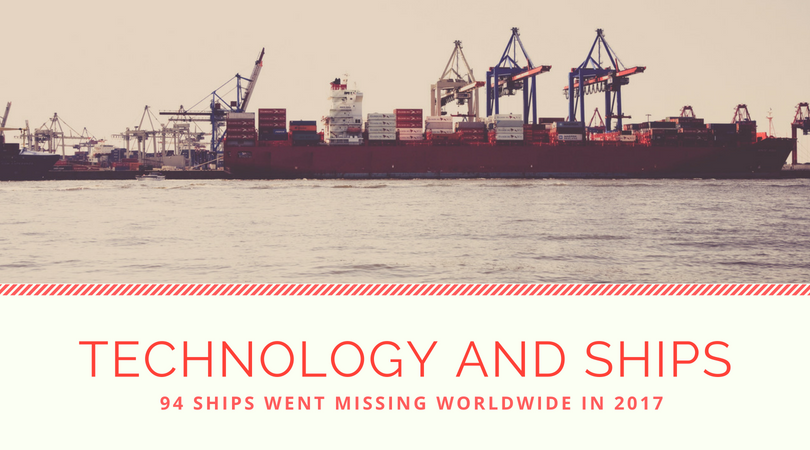
The phenomena of ships going missing is a common occurrence every year. In fact, statistics say that at least two large-sized vessels sink every week throughout the world. And if we consider the yearly number, the estimate reads at around two dozen large-sized vessels going missing or drowned during its course.
Surprised, much? This was just the average estimate as the real count is far more shocking! A recent survey by the World Shipping Council (WSC) has reported that no less than 1,679 containers go missing on a yearly basis. It has also been found that around 100 vessels are destroyed every single year due to untimely foundering, thus bringing about a huge loss in the shipping industry.
The unfortunate incidents not only signify great losses for the companies and the clients but also pose a great threat to the marine environment. It is also quite common if ships go haywire and disappear without any trace. Moreover, South-East Asia is infamous for the notorious activities related to marine piracy and it is best to avoid the particular region.
However, the continuous advancement in the field of technology has been of great use to the marine industry. The usage of various equipment has made it easier to track down vessels in case they function poorly or perhaps go astray. Indeed, the boon of technology has hugely profited the shipping companies and it is gradually developing to provide better solutions to the problematic issue.
Why Did 94 Ships Disappear in 2017?
2017 has brought about winds of change for the marine industry as only 94 vessels have gone missing in the previous year. This figure has been confirmed by the ‘Safety and Shipping Review 2018’ as published by the Allianz organization.
Fortunately, the count has decreased a lot since the earlier years and is declared as the second lowest number in a period of ten years. If compared with the review back in 2016, the losses were have decreased by 4%. This has been possible due to the improved convenience by the correct implementation of technology in the ships.
This, in turn, has transformed the entire world’s sea lanes into a much safer place where a problem can be diagnosed and fixed. The vessels have disappeared, foundered, sunk, or grounded during their voyages across the oceans.
Out of the 94 shipwrecked vessels, Zahro Express (Indonesia), Arca 1 (Panama), Fluvius Tamar (Barbados), Chong Gen (North Korea), Bereket (Turkey), Aram Manis (Singapore), Ocean Eagle (United States) etc. were a few of the notable ones.
The Allianz Report has also stated that out of the 94 missing vessels, 53 were cargo ships that were carrying shipment from one destination to another. In spite of observing several measures for added security, 75%-96% of the tragedies occur due to human error and lack of supervision. The Report has also highlighted an interesting fact that around one-third of the total marine accidents have been identified in the Indonesia, Southern China, Philippines, and Indo-China regions.
It is understood that the container lines are suffering from immense pressure because of the streamlined supply chains and increasingly tight schedules. As a possible suggestion, Allianz believes that predictive analysis can detect error patterns much earlier and can help to prevent accidents. Allianz encourages the proper balance between human interaction and technological intervention to uplift the standards in the shipping industry.
How Has Technology Reduced the Number of Ships Getting Lost?
Technology is slowly taking over the shipping operations and it is not unimaginable that someday the ship captains will become a redundant factor! The containers can now stay connected to the mainland even in the middle of the ocean. In future, the shipping organizations will be able to track and operate their ships with the help of satellite navigation. Nowadays, a majority of the big container vessels are well-equipped with up-to-date satellite communications that have high capacity.
Smart technology has also been introduced to the world of cargo shipping where intermodal containers are being constantly improved, such as in refrigeration. These technology-driven containers can often transfer the assembled data to the mainland via the advanced features of the mobile-phone technology.
Impressive, isn’t it? Wait, there is more. The much-raved concept of automated vessels is seriously in the making and it won’t be long before ships can operate with only a command center and minimal crew support . The automation technology will positively cut down on the human error issue and therefore, lesser ships will go missing in the long run.
The innovative GPS system along with real-time data collection and revamped sensors have taken the navigation system to a whole new level. For instance, Allianz believes that hull stress monitoring sensors can reduce navigational accidents in extreme weather conditions. Allianz also stresses on the usage of drones by maritime surveyors, which will successfully detect vessel damage, monitor pirate activities, supervise rescue operations and last but not the least, assess the level of environmental pollution. The drones are extremely helpful in monitoring the safe routes and have prevented many vessels from the ongoing piracy near the coast of Somalia.
On the other hand, the robotic processing systems can eliminate human error to a great extent. The future calls for container tracking that will enhance the efficiency of the ships. Plus, the cargo tracking technique can also serve as a risk management tool and the shipping organizations can use it when a ship gets lost or gets undergoes any unforeseen damage.
This is one of the benefits that autonomous shipping can bring to the industry. But we’ll get to that in another blog post.


.jpg)