23 November 2020
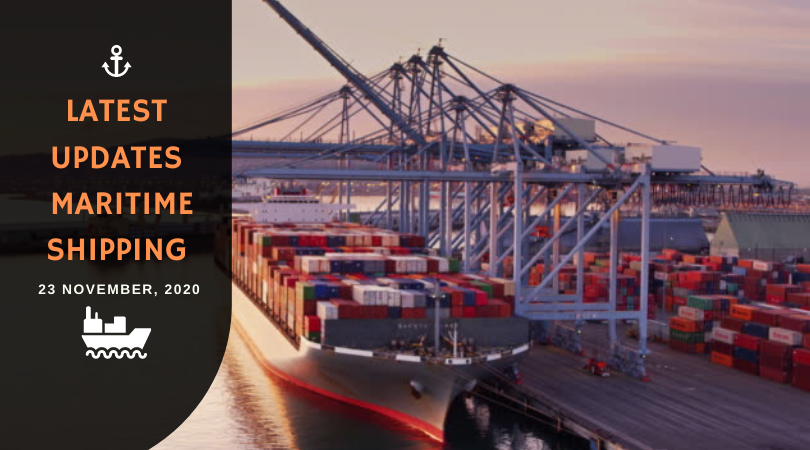
Latest Updates - Maritime Shipping - 23rd November 2020
ICTSI Connects 31 Terminals To TradeLens
Manila-based port operator ICTSI has connected all of its 31 terminals to TradeLens, a blockchain platform jointly developed by IBM and Maersk. ICTSI says the connection to TradeLens allows all its terminals permissioned access to accurate information on cargo movements well in advance of vessel arrivals. TradeLens provides for carriers and cargo owners to exchange transactional information in real time, and also send associated trade documents to permissioned parties. According to TradeLens, its ecosystem now includes more than 175 organisations – extending to more than 10 ocean carriers and encompassing data from more than 600 ports and terminals.
Last month, CMA CGM and Mediterranean Shipping Company (MSC) joined the TradeLens platform as foundation carriers and other recent additions of new ports and terminals include the Commercial Port of Vladivostock, DP World, PT Salam Pacific Indonesia Lines (SPIL), Portbase, QTerminals and Hamad Port, SSA Marine’s Manzanillo International Terminal – Panama (MIT-Panama), Shipwaves, South Asia Gateway Terminals and Yilport Holding.
Smaller Bulk Carriers Dominate
The flourishing bulk carrier sale and buy market saw a small slowdown in the week with smaller vessels dominating the market while tanker sales remain subdued. Allied Shipbroking, Lorentzen & Stemoco, and Intermodal all reported that Greek owner Neda Maritime sold its 2008-built 58,800 dwt supramax bulker Kastro, Port Canton, and Port Dalian to Chinese buyers. The Chinese-built vessels have fetched a price of $9.5m each. More than six shipbroking houses listed the sale of the 2015-built 39,200 dwt handy bulker Lentikia. Italian owner D’Amico sold the Chinese-built vessel to German buyers for $13.8m. The tanker S&P market still lacks support from the chartering market because the crude market has not been ready to push for a recovery. Seasure Shipbroking, Anchor Shipbroking, and Banchero Costa all reported that Swedish owner Stena Bulk sold its 2003-built 47,100 dwt MR2 tanker Stena Conquest. The Croatian-built vessel was sold to Chinese buyers for $9.3m.
Odisha Riding High On Seafood Exports
Odisha features a huge potential to reinforce exports of seafood. We’ve set a target to extend the seafood export by six-fold to offer a lift to the income of the people within the fish trade,” said Sahoo on the occasion of World Fisheries Day. Addressing a function here, the Minister said that the fisheries and aquaculture sector in Odisha has shown a powerful growth of 18.98 pc with the production of around 8.16 lakh tonnes of fish during 2019-20. The typical annual rate of growth of the fish production within the State over the last 5 years is over 14 pc, he added. The Minister said the seafood exports from the State have increased by 78 pc within the last 5 years from Rs 1,817 crore in 2014-15 to Rs 3,243 crore in 2019-20. The State exported over 66,000 plenty of seafood, the bulk of which is frozen shrimp. He said the Odisha received the ‘Best Marine State’ award and the Kalahandi district received the simplest District award in Inland fisheries from the Centre in New Delhi on Saturday.
Petrobras Hunts for Oil Buyers in India
As Brazil’s state-controlled Petrobras PETR4.SA rapidly boosts oil output and exports, executives are looking to a replacement market: India. In an interview as a part of the Reuters Commodity Trading Summit, Chief Executive Roberto Castello Branco said that crude sales to China – an increasingly vital export marketplace for Brazilian oil – would still rise amid strong industrial growth there and therefore the ramping from a number of the world’s largest offshore fields in Brazil. But Petrobras’ newly reorganized marketing and logistics division is actively scouting out additional markets, particularly in Asia. The firm, as an example, has started looking for new buyers in India, which Petroleo Brasileiro SA, because the company is formally known, hopes are going to be a relevant client within three years because it moves to diversify its buyer mix and minimize its dependence on China.
ZIM notches record Q3 net income while Maersk records stunning EBITDA margin of 25.4%
The Israeli carrier, ZIM, notched up a record net income of $144.4m within the three months, while Maersk’s Ocean division stunned with an EBITDA margin of 25.4%, something virtually unprecedented within the history of container shipping. “A stronger-than-expected recovery in demand, following the slowdown of Q2, led to the reactivation of all available tonnage also as significantly higher prices within the short-term market. This, combined with our continued profitability focus, helped us deliver a really strong quarter in Ocean,” Søren Skou, CEO of A.P. Moller – Maersk, commented today. The Danish group’s net income quite doubled to $1.043bn in Q3 on the rear of soaring freight rates. It achieved a large jump in profits despite registering a volume decline of three .6%. “Maersk appears to possess focused on profitability and filling the vessels and foregone some market share,” commented Lars Jensen from Sea Intelligence Consulting on today’s Maersk results. Meanwhile, in Tel Aviv, ZIM’s year-on-year net income improvement for Q3 stood at 2,818%, sending the road into record territory. ZIM’s EBITDA margin beat even Maersk’s, clocking in at 25.9%.
Sources:
https://splash247.com/ictsi-connects-31-terminals-to-tradelens/
https://splash247.com/weekly-broker-smaller-bulk-carriers-dominate/
http://www.maritimegateway.com/odisha-riding-high-seafood-exports/
http://www.maritimegateway.com/petrobras-hunts-oil-buyers-india/
https://splash247.com/zim-notches-record-q3-net-profit-while-maersk-records-stunning-ebitda-margin-of-25-4


.jpg)