
Why eBL Is the Next Step in Paperless Trade
From document movement to digital control
For generations, global trade has relied heavily on original paper Bills of Lading. They had to be stamped, couriered, chased, and physically handed from one party to the next before a container could be released. At ODeX, we saw this friction play out across every trade lane we served, and we knew paper had become the slowest link in an otherwise fast-moving supply chain.
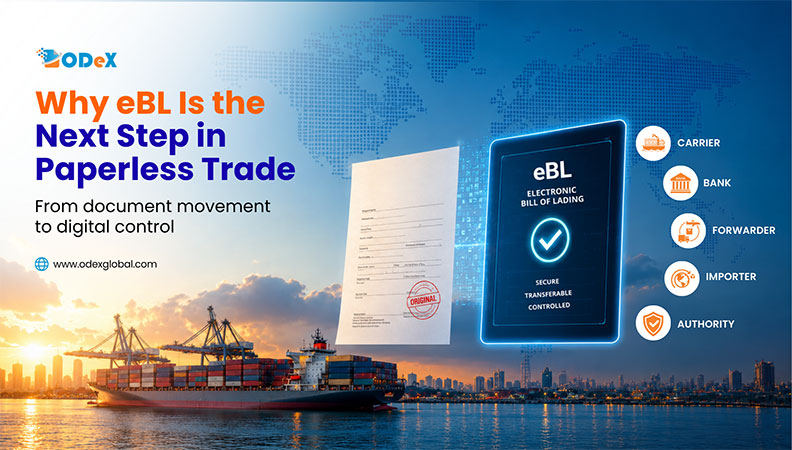
That's why we launched our electronic Bill of Lading (eBL) solution, in partnership with IQAX, as the next major milestone in our paperless trade journey. Through the collaboration between GSBN, ODeX, and IQAX, users can receive, transfer, and surrender IQAX eBLs directly within the ODeX workflow. It isn't a scanned copy or a PDF sent by email. It is a secure, transferable, and controlled digital original designed to perform the functions of a paper Bill of Lading, subject to applicable laws, carrier acceptance, and platform rules.
What Is an Electronic Bill of Lading (eBL)?
Before we get into what we built, here's a quick refresher on what a Bill of Lading actually does. It is one of the most important documents in international shipping, and depending on the shipment and document type, it typically serves three functions:
-
Receipt of cargo — confirmation that the carrier has received the goods for shipment
-
Evidence of the contract of carriage — the terms under which the carrier agrees to transport the cargo
-
Document of title or control — in many cases, the rightful holder can use it to claim or control delivery of the goods
We designed our eBL to preserve all three functions while replacing the physical paper with a secure digital record. Instead of printing and couriering an original BL, we enabled authorized parties to receive, view, transfer, endorse where applicable, and surrender the Bill of Lading entirely online. No waiting for a physical original to change hands.
Why We Moved to eBL
The traditional paper BL process was slow and operationally fragile. It depended on physical handover, manual verification, courier movement, and multiple follow-ups between shippers, consignees, agents, carriers, banks, and terminals. Every one of those steps was a point where a document could be delayed, misplaced, or disputed, and we saw customers feel that pain directly.
Two forces shaped our decision to move first:
-
Carrier commitments: DCSA member carriers publicly committed to converting 50% of original bills of lading to digital format within five years, and 100% by 2030.
-
Legal foundations: UNCITRAL's Model Law on Electronic Transferable Records (MLETR) gave electronic transferable records a legal foundation to be used domestically and across borders, subject to each jurisdiction's own adoption and legal framework.
We didn't want to wait for the industry to catch up. We built our eBL capability so our customers could get ahead of it.
From Document Movement to Digital Control: How Our eBL Process Works
When we designed the ODeX x IQAX eBL flow, we mapped it to the exact journey a Bill of Lading takes, from booking to cargo release. Here's how it runs, now that we've brought the process live:
-
Shipment booking and movement — the shipper books the shipment and cargo moves through the normal shipping process.
-
BL data preparation — BL details are prepared and verified by the relevant parties per carrier requirements.
-
eBL issuance — the shipping line issues the Bill of Lading electronically through our supported eBL platform.
-
Digital access — the authorized party gets instant access to view document status, holder status, and shipment milestones.
-
Transfer or endorsement — the eBL can be transferred digitally to the consignee, buyer, bank, forwarder, or other authorized party.
-
Agent authorization — the consignee can authorize a customs broker, forwarder, or agent to act on its behalf.
-
Digital surrender — the rightful holder surrenders the eBL digitally to initiate release.
-
Digital Delivery Order (DO) workflow — surrender triggers or supports our connected DO process, along with payment and documentation requirements.
-
Cargo release — once approvals, payments, and release conditions are complete, cargo release proceeds entirely through our digital ecosystem.
Compare that to the paper process we replaced — printing, physical release, courier movement, manual follow-up, and a physical original that had to be surrendered before cargo could move — and the operational gap is clear. We didn't just digitize a document; we replaced uncertainty with traceable, real-time control at every stage.
Who Benefits from Our Connected eBL Ecosystem
We built eBL to support participants across the EXIM chain, not just one party. The connected eBL ecosystem is designed to support:
-
Carriers — issue the eBL and manage digital surrender for release, with lower paper handling, reduced fraud risk, and faster release operations.